
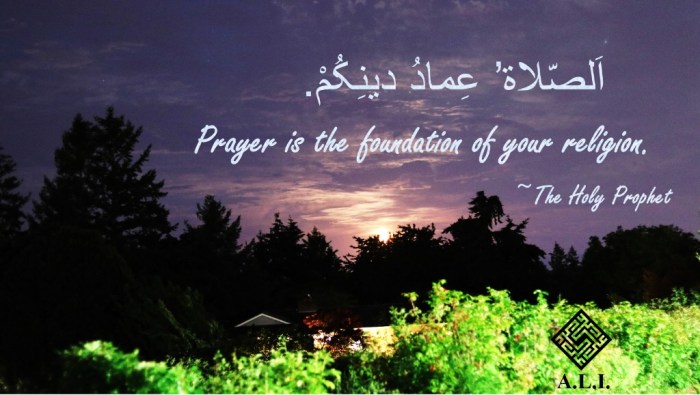
The true meaning of Salaat (the daily prayer)
Salaat is a demonstration of ‘politeness’ in the presence of God, while worshiping Him. We have other forms of worship that do not involve the specific rituals of salaat, such as uttering zikr (recitations in praise of Allah) or reciting dua (suplications). Salaat is this unique ‘politeness’ of the servant in front of the true Master. At any given time, one can recite the words of the salaat (prayer) verbatim, yet this is not recognized as salaat. Bowing (rukoo) and prostration (sujood) after recitation of the Qur’an are also forms of courtesy and ‘politeness’ in front of the Lord of the heavens and the earth.
Why should we perform salaat as is?
Many people believe in God and they also acknowledge that there should be a connection between the servant and the Master. However, when it comes to salaat they say “why should we perform and repeat the salaat as is, at fixed times every day, after performing ablution etc.? Why can’t we just remember God and recite zikr as we see fit, for example while resting”. As described above, the essence of the salaat ritual is demonstrating appropriate manners in the presence of God.
Naturally, “manners” are defined differently in each culture; what is deemed polite in one culture might be neutral or even rude in another. Therefore it is important to recognize, that God, and only God can define courteous manners in His presence and prescribe specific rituals to be performed for Him.
Love vs respect in salaat?
Any servant who wants to form a connection with God should remember the definition of ‘politeness’ as defined by God and align him/herself with this definition. Therefore as a servant you perform salaat at the times He has recommended in the way He has described. If salaat is viewed through this lens, then most questions that come to mind become self explanatory. Someone who views salaat purely as an expression of love towards the Master, may find him/her self wavering in this sacred ritual at times when they do not ‘feel’ the love. The rational element within the soul of man however, can consistently understand the importance of respect for the Lord, and this in itself can lead to perseverance in salaat and a deeper connection with the Almighty.
Essentially, acting in a humble, polite manner towards the Lord, in accordance with His prescriptions can be uplifting for the human spirit and will strengthen our love for Him. It is important to remember that this politeness and respect is a minimum yet essential prerequisite. The continual practice of salaat by the servant elevates him/her through the many levels of perfection that can be attained by the soul.
~Sheikh Alireza Panahiyan

The Ahlul Bayt (peace be upon them) have taught us numerous recommended actions to be performed before, during and after the formal prayer (salaat).
Some of the recommended acts to be performed before entering the prayer include:
1. Brush ones teeth, wear clean, nice clothes and put perfume.
2. Perform ablution (wudhoo) including rinsing the mouth and nose.
• use little water; avoid waste
• ask God to wash away your sins as you wash your face and hands.
• as you wipe your feet, ask God to help you walk on the right path.
3. Direct your focus to Allah, and this special meeting with Him.
• write down a to do list for yourself, so that you are not thinking about what needs to be done while in the prayer.
4. Recite the adhan and iqamah before each prayer.
5. Make your intention for the specific prayer, and recite “Allahu Akber” “God is the greatest” 7 times.
• with each “Allahu Akber” think you are pushing away everything related to this world (dunya) as you enter the prayer.
Lets challenge ourselves to implement these acts before entering into the prayer in order to make the most of this special meeting with our Lord.
Sayed Abazar Wahedi ( Mahdi )


Such a important share.inshaAllah we all increase in doing these🙏🏼
God is great and merciful .
LikeLiked by 2 people