
24th of Dhul-Ḥijjah
Eid al-Mubāhalah
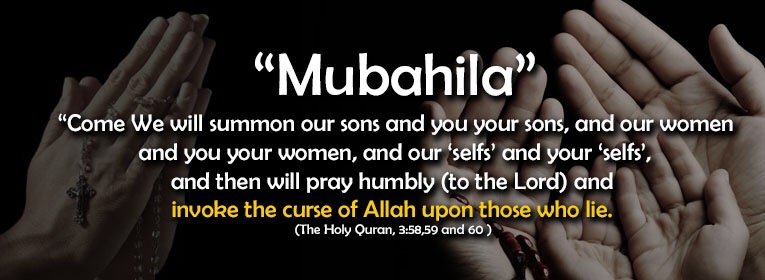
The 24th of Dhul-Ḥijjah marks the day that the Holy Prophet (s) was about to engage in mubāhalah with a group of Christians from the city of Najrān. This group, which included some Christian scholars, came to Madinah in the year 9AH to visit the Prophet (s) and inquire about Islam. After discussions, the Christians refused to submit to the logical arguments and proofs that the Prophet (s) showed them. In response, Allah called the Christians to engage in mubāhalah with the Prophet (s); that is, each side should pray to Allah to send His punishment down on whoever is the liar from them:
فَمَنْ حَاجَّكَ فِيهِ مِن بَعْدِ مَا جَاءَكَ مِنَ الْعِلْمِ فَقُلْ تَعَالَوْا نَدْعُ أَبْنَاءَنَا وَأَبْنَاءَكُمْ وَنِسَاءَنَا وَنِسَاءَكُمْ وَأَنفُسَنَا وَأَنفُسَكُمْ ثُمَّ نَبْتَهِلْ فَنَجْعَل لَّعْنَتَ اللَّـهِ عَلَى الْكَاذِبِينَ
Should anyone argue with you concerning it [the truth], after the knowledge that has come to you, say, ‘Come! Let us call our sons and your sons, our women and your women, our souls and your souls, then let us pray earnestly, and call down Allah’s curse upon the liars.’ (3:61)
Both parties agreed that the next day they would meet outside of the city of Madinah for the mubāhalah. The next day the Messenger of Allah (s) gathered Imam ‘Ali, Lady Fāṭimah, Imam al-Ḥasan and Imam al-Ḥusayn peace be upon them all, under his ‘abā’ (cloak) and said
اللهمّ انّه قد كان لكلّ نبيّ من الانبياء أهل بيت هم أخصّ الخلق اليه، اللهمّ وهؤلاءِ أهل بيتي فأذهب عنهم الرِّجس وَطهّرهم تطهيراً
O Allah! Surely every prophet from the prophets had an Ahlul Bayt (people of their house) that were the closest of all creation to him. O Allah these are my Ahlul Bayt, so repel all impurity from them and purify them with a thorough purification.
At this time the angel Jibrā’īl descended with the verse of taṭhīr, revealed in honor of the Ahlul-Bayt (a). After this the Prophet (s) came out with his family, ready for the mubāhalah. When the Christians saw the pure faces of the Prophet (s) and his noble family, they realized that the truth was with them and decided not to engage in mubāhalah. Instead they asked the Prophet to instead sign a treaty with them.
Lesson: Showing the Truth
In an unprecedented move, the Holy Prophet (s) brought his family out into the open with him on the day of mubāhalah. The most dear of all people to him, were those whom he brought into the field on that day: Lady Fāṭimah, Imam ‘Ali, Imam al-Ḥasan and Imam al-Ḥusayn (a). An important lesson for us to take out of this story, is that in the same way the Prophet (s) gave so much importance to showing other people the truth, we today must also try our best to show people the true message of Islam.
Imam Ali (a) gives Charity while in Ruku’; Revelation of Verse of Wilayah
This is also the day, in the year 10 AH, in which Imam Ali (a) gave his ring in charity to a beggar in the mosque of the Prophet (s) while in Ruku’. As a result, the verse of Wilayah was revealed, saying,
إِنَّما وَلِيُّكُمُ اللَّهُ وَ رَسُولُهُ وَ الَّذينَ آمَنُوا الَّذينَ يُقيمُونَ الصَّلاةَ وَ يُؤْتُونَ الزَّكاةَ وَ هُمْ راكِعُونَ
Your guardian is only Allah, His Apostle, and the faithful who maintain the prayer and give the zakat while bowing down. (Al-Ma’ida 5:55)
Revelation of Surah Hal Atā (Surah al-Insān)
It was also on this day (or the 25th of the month, according to some repots), in the year 7 AH, in which Surah al-Insān (76) was revealed in honor of the selfless sacrifice of the household of Imam Ali (a) who gave away their iftar three days in a row to a needy person, an orphan, and a freed prisoner.
Recommended Acts
Among the recommended acts for this day are:
1- Recitation of the Du’a of Mubāhalah. It is reported from that Imam as-Sadiq (a) has said that this Du’a contains the greatest name of Allah, and had people known the power of this du’a to fulfill one’s needs, they would have tried with all their might to learn this Du’a. He also said that whenever he would have a request of Allah, he would recite this Du’a and it would be fulfilled.
2- Giving charity.
Thank you for reading .
Salam alaikom .
Sayed Abazar Wahedi ( Mahdi ) .
 Sayed Abazar Wahedi